Written by Dr Mark Wilshere and Dr Marc Crutchley, GMC-registered GPs and founders of Dr Marks. Medically reviewed by Dr Mark Wilshere MBChB MRCGP DCH BSc (Hons).
The short answer: no, you don't need vitamin K2 to benefit from vitamin D. NHS advice is simply to consider 10 micrograms (400 IU) of vitamin D a day in autumn and winter, and all year round if you're at higher risk. Vitamins D and K both contribute to the maintenance of normal bones, which is why they're often sold together. Research on whether adding K2 makes a real difference is mixed. And if you take warfarin, you should avoid vitamin K supplements.
What vitamin D does
Vitamin D contributes to normal absorption and utilisation of calcium and phosphorus. It also contributes to the maintenance of normal bones, teeth and muscle function, and to the normal function of the immune system.
In the UK, we don't make enough vitamin D from sunlight between October and early March. That's why the NHS says everyone should consider a daily 10 microgram supplement during the autumn and winter. Some groups are advised to take it all year, including people who rarely go outdoors, live in a care home, cover most of their skin when outside, or have dark skin. Our guide to how much vitamin D you need in a UK winter covers this in more detail.
What is vitamin K2?
Vitamin K is a group of related compounds:
- Vitamin K1 (phylloquinone) is the main form in the diet. It's found in green leafy vegetables such as broccoli and spinach, vegetable oils and cereal grains.
- Vitamin K2 (menaquinones) is a family of forms found in smaller amounts in some animal and fermented foods. MK-7 is the form most often used in supplements.
Vitamin K contributes to normal blood clotting and to the maintenance of normal bones. The NHS says adults need about 1 microgram of vitamin K a day for each kilogram of body weight, roughly 65 micrograms for someone weighing 65kg. Most people get enough from a varied diet.
Why are D3 and K2 sold together?
Both vitamins have authorised roles in maintaining normal bones, and they work in related ways:
- Vitamin D helps your body absorb calcium from food.
- Vitamin K is needed to activate certain proteins, including osteocalcin, a protein made by bone cells.
Pairing them is therefore biologically logical. Logical isn't the same as proven, though, so it's worth looking at what the trials actually show.
What does the research say?
The evidence is mixed:
- A Dutch trial gave 244 healthy postmenopausal women either 180 micrograms of MK-7 or a placebo for three years. The MK-7 group lost less bone mineral density at the lower spine and the top of the thigh bone, but not across the hip as a whole.
- A 2019 review of 36 trials of vitamin K supplements (published in Osteoporosis International) was less encouraging. In postmenopausal women and people with osteoporosis it found no clear effect on vertebral fractures, and the bone density results were inconsistent. There was a possible reduction in other fractures, but the authors felt the evidence wasn't strong enough to be sure.
Our honest summary is that K2 is interesting, but the evidence isn't settled. For most people, vitamin D on its own, as the NHS advises, is the priority.
How much vitamin D is safe?
The NHS says 10 micrograms a day will be enough for most people. Adults should not take more than 100 micrograms (4,000 IU) a day, as this could be harmful. Too much vitamin D over a long period can cause calcium to build up in the blood (hypercalcaemia), which can weaken bones and damage the kidneys and heart. Some medical conditions mean people can't safely take as much, so if in doubt, ask your doctor.
A quick conversion: 1 microgram of vitamin D equals 40 IU, so 10 micrograms is 400 IU and 100 micrograms is 4,000 IU. Check every product you take, because vitamin D also turns up in multivitamins and in fish liver oils such as cod liver oil.
Who should not take vitamin K2
- People taking warfarin. The NHS advises not taking vitamin K supplements with warfarin, because vitamin K affects how warfarin works. In one study, as little as 10 micrograms of MK-7 a day changed blood-clotting test results in some people on a similar anticoagulant.
- People taking any other anticoagulant. Check with your GP or pharmacist first.
- People with a long-term medical condition, particularly one affecting the kidneys or calcium levels. The NHS notes that some medical conditions mean people may not be able to safely take as much vitamin D, so speak to your doctor before taking a high-dose product.
Further reading on our blog:
- Vitamins for over 50s
- Vitamin K: what it does and where to find it
- Calcium: what it does and where to find it
When to see your GP
See your GP if you have:
- bone pain, muscle weakness or aches that don't settle
- a history of broken bones from minor falls, or you're worried about osteoporosis
- a long-term condition, or you take regular medicines, especially an anticoagulant
- you take a high-dose vitamin D supplement and feel unwell, or you're unsure whether your total daily dose from all products is safe
Your GP can arrange a blood test if it's appropriate and can advise on the right dose for you.
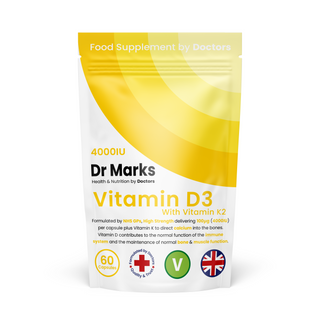
Dr Marks Vitamin D3 + K2
Our Vitamin D3 + K2 provides 100 micrograms (4,000 IU) of vitamin D3 and 100 micrograms of vitamin K2 (MK-7), in coconut oil, in each one-a-day capsule. It's suitable for vegetarians.
Vitamin D contributes to the maintenance of normal bones and normal muscle function, and to the normal function of the immune system. Vitamin K contributes to the maintenance of normal bones.
Please be clear about the strength: one capsule is ten times the NHS everyday amount and the maximum daily intake the NHS advises for adults, so it isn't right for everyone. Don't combine it with any other product containing vitamin D. It contains vitamin K, so if you take anticoagulant medicine such as warfarin, speak to your GP, pharmacist or anticoagulation clinic first. If you take another anticoagulant or have a long-term condition, check with your GP first.
Visit our website to find out more about Dr Marks Vitamin D3 + K2.
Food supplements should not replace a varied, balanced diet and healthy lifestyle.
Frequently asked questions
Do I need to take K2 with vitamin D?
No. NHS advice is about vitamin D alone, and you'll benefit from vitamin D without K2. Some people choose a combined product, but the extra benefit of K2 hasn't been firmly established.
Is 4,000 IU of vitamin D too much?
4,000 IU (100 micrograms) is the most the NHS advises adults take in a day. It's safe for most adults at that level, but it's the upper limit, so don't add other vitamin D on top. Some people with medical conditions should take less.
Can I take vitamin K2 if I'm on warfarin?
No, not without speaking to your anticoagulation clinic or GP. The NHS advises against vitamin K supplements with warfarin, because they can change how warfarin works.
What's the difference between vitamin K1 and K2?
K1 is the main dietary form, found in leafy greens. K2 comes in several forms found in smaller amounts in some animal and fermented foods. Both are vitamin K, and the authorised claims apply to vitamin K as a whole.
Should I take vitamin D3 and K2 with food?
Both are fat-soluble, so many people take them with a meal. Follow the directions on the pack.
Can I take D3 + K2 with a multivitamin?
Only if the multivitamin contains no vitamin D. Otherwise you could go over the NHS upper limit of 100 micrograms a day.
References
- NHS. Vitamins and minerals: vitamin D. https://www.nhs.uk/conditions/vitamins-and-minerals/vitamin-d/ (accessed 19 October 2026)
- NHS. Vitamins and minerals: vitamin K. https://www.nhs.uk/conditions/vitamins-and-minerals/vitamin-k/ (accessed 19 October 2026)
- NHS. Warfarin. https://www.nhs.uk/medicines/warfarin/ (accessed 19 October 2026)
- British Dietetic Association. Vitamin D: food fact sheet. https://www.bda.uk.com/resource/vitamin-d.html (accessed 19 October 2026)
- Knapen MH et al. (2013). Three-year low-dose menaquinone-7 supplementation helps decrease bone loss in healthy postmenopausal women. Osteoporosis International 24(9):2499-507. https://pubmed.ncbi.nlm.nih.gov/23525894/ (accessed 19 October 2026)
- Mott A et al. (2019). Effect of vitamin K on bone mineral density and fractures in adults: an updated systematic review and meta-analysis of randomised controlled trials. Osteoporosis International 30(8):1543-59. https://pubmed.ncbi.nlm.nih.gov/31076817/ (accessed 19 October 2026)
- Theuwissen E et al. (2013). Effect of low-dose supplements of menaquinone-7 (vitamin K2) on the stability of oral anticoagulant treatment: dose-response relationship in healthy volunteers. Journal of Thrombosis and Haemostasis 11(6):1085-92. https://pubmed.ncbi.nlm.nih.gov/23530987/ (accessed 19 October 2026)
- Scientific Advisory Committee on Nutrition (2016). Vitamin D and health. https://www.gov.uk/government/publications/sacn-vitamin-d-and-health-report (accessed 19 October 2026)
- Department of Health and Social Care. Great Britain nutrition and health claims (NHC) register. https://www.gov.uk/government/publications/great-britain-nutrition-and-health-claims-nhc-register (accessed 19 October 2026)
Food supplements should not replace a varied, balanced diet and healthy lifestyle. Do not exceed the stated daily dose. Keep out of reach of children. If you are pregnant, breastfeeding, taking any medication or under medical supervision, speak to your GP or pharmacist before taking supplements. This article is general information and is not a substitute for personal medical advice. Dr Marks is an independent company and is not affiliated with or endorsed by the NHS.
About the authors
Dr Mark Wilshere MBChB MRCGP DCH BSc (Hons), GP and Co-Founder, Dr Marks (medical reviewer)
GMC no. 6144605
Dr Marc Crutchley MBChB MRCGP MSc BSc (Hons), GP and Co-Founder, Dr Marks
GMC no. 6144602
Last reviewed: 19 October 2026
Find out how we write, check and update our health content: our medical review process.