Written by Dr Mark Wilshere and Dr Marc Crutchley, GMC-registered GPs and founders of Dr Marks. Medically reviewed by Dr Mark Wilshere MBChB MRCGP DCH BSc (Hons).
The short answer: it depends on why you're low in B12. If your body can't absorb B12 from food, for example because of autoimmune gastritis (pernicious anaemia) or certain stomach or bowel surgery, NICE advises lifelong B12 injections. If the cause is mainly diet, such as a fully plant-based diet without fortified foods or supplements, tablets are usually an option. Research suggests high-dose tablets can raise B12 levels about as well as injections in the right people. The key first step is a proper diagnosis from your GP.
Why B12 matters
Vitamin B12 contributes to normal red blood cell formation and to normal functioning of the nervous system. It's found in meat, fish, milk, cheese and eggs, and is added to some fortified breakfast cereals and plant milks. Adults need about 1.5 micrograms a day.
The NHS lists these symptoms of B12 deficiency:
- extreme tiredness and lack of energy
- pins and needles
- a sore, red tongue
- mouth ulcers
- muscle weakness
- problems with your vision
- low mood, memory problems or confusion
Some nerve problems caused by B12 deficiency can be permanent if they're not treated promptly, which is why diagnosis matters.
How your body absorbs B12
To absorb B12 from food, your stomach makes a protein called intrinsic factor, which carries B12 to the end of your small bowel (the ileum). Several things can disrupt this:
- Autoimmune gastritis (pernicious anaemia). Your immune system attacks the stomach lining and intrinsic factor production stops. The NHS says pernicious anaemia is the most common cause of B12 deficiency in the UK.
- Surgery. Removal of the stomach or the end of the small bowel.
- Bowel conditions. For example, coeliac disease.
- Medicines. These include metformin and acid-reducing medicines such as proton pump inhibitors (PPIs). See our posts on metformin and B12 and indigestion medicines.
B12 deficiency becomes more common with age. The NHS estimates that B12 or folate deficiency affects around 1 in 10 people aged 75 or over.
When injections are needed
NICE guidance (NG239, 2024) advises lifelong B12 injections for people whose deficiency is caused, or suspected to be caused, by autoimmune gastritis, and for people who have had a total gastrectomy or complete removal of the end of the small bowel.
In the UK, injections usually use hydroxocobalamin, because it stays in the body longer. The NHS describes injections every other day at first, then usually every two to three months for life if the cause isn't diet. People who've had nerve symptoms may be referred to a haematologist and need injections more often.
For other causes of malabsorption, such as coeliac disease or some types of weight-loss surgery, NICE suggests considering injections rather than tablets. If tablets are used, the dose should be at least 1mg (1,000 micrograms) a day.
When tablets may be enough
If your deficiency is caused by diet, NICE advises considering oral B12, alongside advice on food sources. Injections may still be preferred if you have nerve or blood problems, if you're frail or older and recently in hospital, or if taking tablets reliably would be difficult.
For deficiency caused by a medicine (such as metformin), NICE says either tablets or injections can be used, based on your GP's judgement and your preference.
NICE also advises that if you choose an over-the-counter supplement, you should pick one containing at least one of these forms: cyanocobalamin, methylcobalamin or adenosylcobalamin. Some over-the-counter products differ considerably in strength and form of vitamin B12.
What does the research say?
A 2018 Cochrane review compared oral and injected B12 in three randomised trials (153 people):
- In two trials using 1,000 micrograms a day of oral B12, blood levels were no different in any clinically meaningful way from injections.
- One trial using 2,000 micrograms a day found higher levels with tablets.
- Tablets cost less.
The reviewers rated the evidence as low quality, because the trials were small. None measured symptoms or quality of life, so the evidence is encouraging but not conclusive.
| Injections (hydroxocobalamin) | High-dose tablets | |
|---|---|---|
| Needed for | Autoimmune gastritis, total gastrectomy, complete ileal resection | Often suitable for diet-related deficiency |
| Given by | GP or practice nurse | Taken daily at home |
| Works if intrinsic factor is missing? | Yes | Not recommended in place of injections for these causes |
| Evidence | Long-standing standard treatment | Low-quality evidence of similar effect on blood levels |
Get tested before you start supplements
This is the most important practical point. NICE notes that over-the-counter B12, including tablets, injections and patches, can raise blood test results without fully treating a deficiency. If you think you might be low, see your GP before you start taking B12, and tell them about anything you're already taking.
Further reading on our blog:
- Vitamin B12: what it does and where to find it
- Important information if you have type 2 diabetes
- Are there additional risks of being vegetarian?
When to see your GP
See your GP if:
- you have any of the symptoms above, especially pins and needles, numbness, problems with balance or walking, or memory changes (seek help promptly if these are new or getting worse)
- you take metformin or a PPI long term
- you follow a fully plant-based diet and don't take B12 or eat fortified foods
- you've had stomach or bowel surgery
- you're on B12 treatment and your symptoms haven't improved, or have come back
NICE notes that symptoms may start to improve within a couple of weeks of treatment, but it can take up to three months.
Dr Marks Triple B12
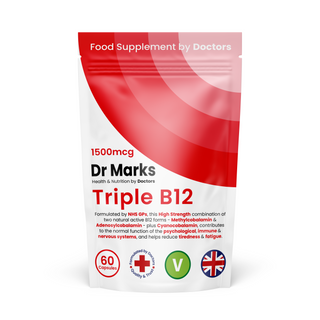
Triple B12 provides 1,500 micrograms of vitamin B12 per one-a-day capsule, from three forms: cyanocobalamin, methylcobalamin and adenosylcobalamin. It's suitable for vegans and vegetarians. Made in a factory that also handles milk, egg, fish and crustaceans.
Vitamin B12 contributes to normal red blood cell formation, to normal functioning of the nervous system, to the reduction of tiredness and fatigue, to normal energy-yielding metabolism and to normal psychological function. The NHS says 2mg (2,000 micrograms) or less a day from supplements is unlikely to cause harm.
If you've been diagnosed with B12 deficiency or pernicious anaemia, follow the treatment your GP advises rather than relying on a food supplement. Never stop prescribed injections without talking to your GP.
Visit our website to find out more about Dr Marks Triple B12.
Food supplements should not replace a varied, balanced diet and healthy lifestyle.
Frequently asked questions
Are B12 tablets as good as injections?
For diet-related deficiency, high-dose tablets can raise B12 levels about as well as injections, according to low-quality evidence. If you have pernicious anaemia (autoimmune gastritis), NICE advises lifelong injections.
Can I switch from B12 injections to tablets?
Only after talking to your GP. If your deficiency is caused by autoimmune gastritis or surgery, injections are the recommended treatment for life. If the cause was diet or a medicine, your GP may discuss tablets.
Should I take B12 before a blood test?
Ideally not. Over-the-counter B12 can raise your test result without fixing a deficiency. Tell your GP about any supplements you take.
How long do B12 tablets take to work?
NICE notes that symptoms may improve within two weeks to three months of starting treatment. Your GP will usually review you at about three months.
Can you take too much B12?
The NHS says there isn't enough evidence on the effects of high doses over time, but 2mg or less a day from supplements is unlikely to cause harm.
Do people on a plant-based diet need B12 supplements?
Usually, yes. B12 isn't found in plant foods unless they're fortified, so people who eat no animal products need fortified foods or a supplement. The NHS notes some may need tablets for life.
References
- National Institute for Health and Care Excellence (2024). Vitamin B12 deficiency in over 16s: diagnosis and management (NG239). https://www.nice.org.uk/guidance/ng239/chapter/Recommendations (accessed 19 October 2026)
- NHS. Vitamin B12 or folate deficiency anaemia. https://www.nhs.uk/conditions/vitamin-b12-or-folate-deficiency-anaemia/ (accessed 19 October 2026)
- NHS. Vitamin B12 or folate deficiency anaemia: treatment. https://www.nhs.uk/conditions/vitamin-b12-or-folate-deficiency-anaemia/treatment/ (accessed 19 October 2026)
- Wang H et al. (2018). Oral vitamin B12 versus intramuscular vitamin B12 for vitamin B12 deficiency. Cochrane Database of Systematic Reviews 3:CD004655. https://pubmed.ncbi.nlm.nih.gov/29543316/ (accessed 19 October 2026)
- NHS. Vitamins and minerals: B vitamins and folic acid. https://www.nhs.uk/conditions/vitamins-and-minerals/vitamin-b/ (accessed 19 October 2026)
- NICE Clinical Knowledge Summaries. Anaemia: B12 and folate deficiency. https://cks.nice.org.uk/topics/anaemia-b12-folate-deficiency/ (accessed 19 October 2026)
- British National Formulary. Hydroxocobalamin. https://bnf.nice.org.uk/drugs/hydroxocobalamin/ (accessed 19 October 2026)
- Department of Health and Social Care. Great Britain nutrition and health claims (NHC) register. https://www.gov.uk/government/publications/great-britain-nutrition-and-health-claims-nhc-register (accessed 19 October 2026)
Food supplements should not replace a varied, balanced diet and healthy lifestyle. Do not exceed the stated daily dose. Keep out of reach of children. If you are pregnant, breastfeeding, taking any medication or under medical supervision, speak to your GP or pharmacist before taking supplements. This article is general information and is not a substitute for personal medical advice. Dr Marks is an independent company and is not affiliated with or endorsed by the NHS.
About the authors
Dr Mark Wilshere MBChB MRCGP DCH BSc (Hons), GP and Co-Founder, Dr Marks (medical reviewer)
GMC no. 6144605
Dr Marc Crutchley MBChB MRCGP MSc BSc (Hons), GP and Co-Founder, Dr Marks
GMC no. 6144602
Last reviewed: 19 October 2026
Find out how we write, check and update our health content: our medical review process.